Revenant Gun and Maven Stratagem
by Yoon Ha Lee
Published By Solaris
Author's Site
A few years ago I reviewed Ninefox Gambit, a book I really enjoyed. It had everything I want in epic military scifi - spaceships, huge stations, massive battles, weird quasi-magical powers, and self-destructive fractional politics. You can read my full review here. Do the two followup books meet the same high standard? I finally got around to finding out.
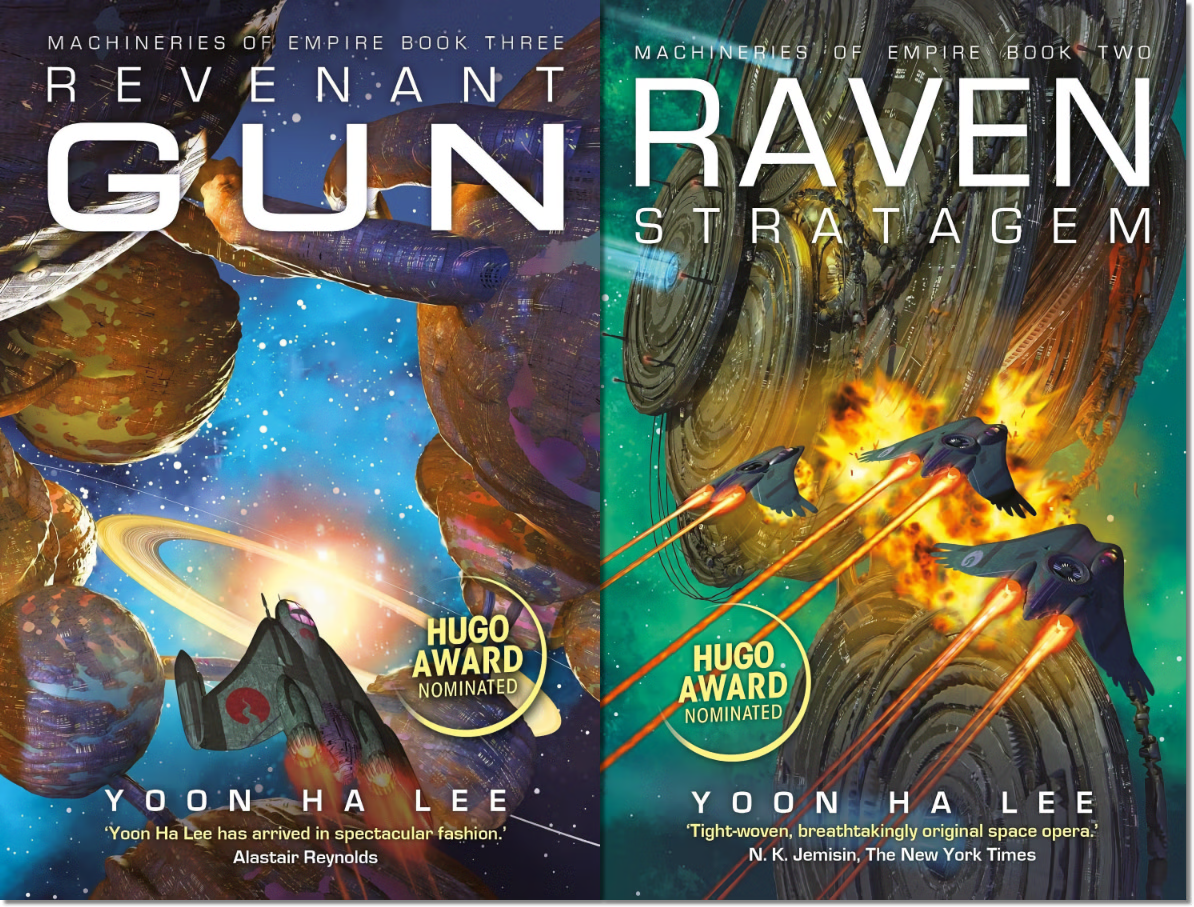
Unlike a lot of scifi trilogies these days, the first book is pretty much stand alone. Not so with these two - the reader is dumped back into the world with nary a synopsis. Also, there is a 9 year time jump, so I was a little disoriented but I soon found my feet. The hexarchate is still as fractured as ever, mired in doctrine hundreds of years old. To big to be conquered but unable to contain the heretic General Shuos Jedao as they rampage across hexarchate territory.
All the things I liked about Ninefox Gambit are still here - the imposed calendar systems that modify the physical rules in a region of space is one of my favorite conceits in scifi. The helpful robots that have their own agenda (and their own factions). The wonderful semi-organic spaceships of the hexarchate flying around. All great stuff.
Unfortunately, the later books also contain a lot of what I didn't enjoy - stuffy political posturing from characters that play very little in part in the plot. Whole chapters taken place far from the action following subplots that don't really go anywhere. Flashbacks to events that don't really matter. Rediculously contrived gambits and counter-gambits that just happen to work out. Frankly, I found both Revenant Gun and Maxen Stratagem a bit of a slog to get through.
The writing is a good as ever, and the battles are exciting but I found myself not caring about the outcome. This time around there is just too much background to absorb, which is made most worse by everyone having ridiculous space names. Keeping track of whom is aligned with whom while secretly being in league with whom because of something someone else did 400 years ago is very difficult.
Needless to say there is a lot going on. And some of the themes I really liked, such as what the servitors were up to and the non-human intelligences. But the passages dealing with these are spread thin amongst long chapters concerned with arcane points of protocol. The writing is brisk but I sometimes just wished each book with just get to the good parts.
Despite my misgivings, I did find some things to enjoy and I am glad I took the time to finally finish the Machineries of Empire novels. If you can put up with lengthy digressions then they are a fairly agreeable, Yee's prose is very readable. I see from Wikipedia that there is a novella out there that completes the story - I'll read it if I come to it but I am not about to go tracking it down.