Travel brings up amazing contrasts. Sometimes you are eating croissants on a high-speed train zooming through Europe. Sometimes you sipping wine in a huge metal tube flying over Greenland's icecaps.
And sometimes you find yourself on a bus to Hamilton to meet with your financial advisor.
Today is of the latter variety so I thought I would take the opportunity to blog some recent reading.
An Immense World
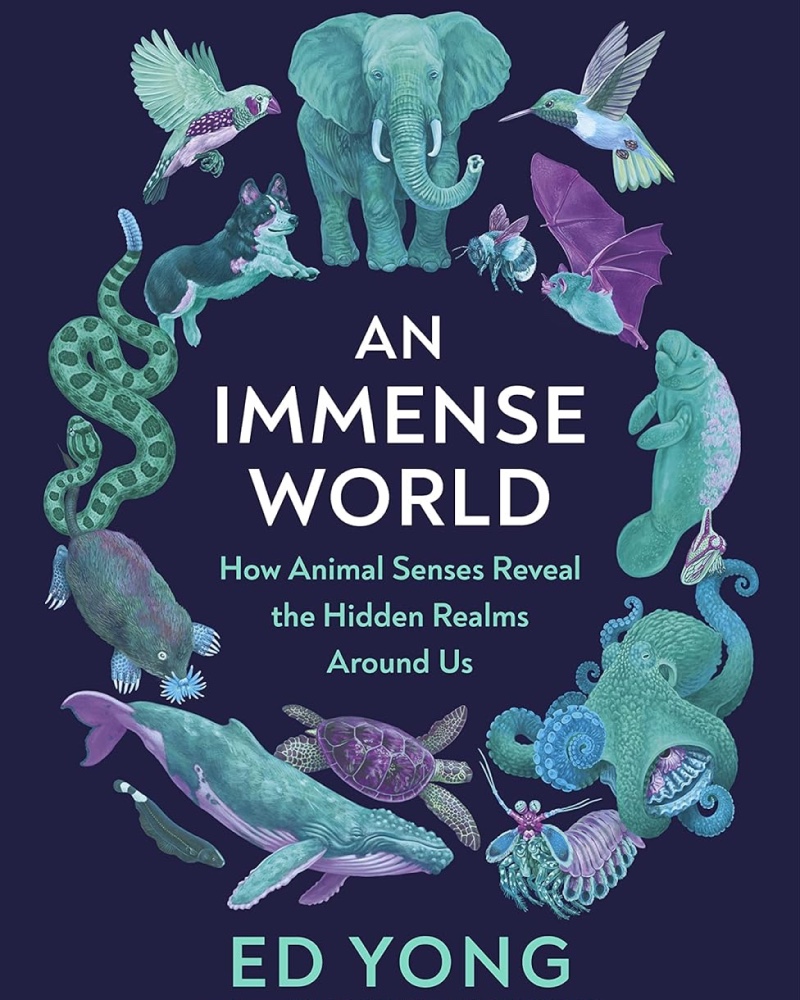
An Immense World : How Animal Senses Reveal the Hidden Realms Around Us
Ed Young
Humans experience only a small fraction of our immediate environment. All around us there are sounds, smells, colors, and even things like magnetic fields that we simply do not perceive. Animals with differently tuned or novel-to-us senses live in completely different worlds despite sharing the same physical planet with us.
An Immense World is a tour of these experiences, backed up with new researchIt is a little annoying to find that I am old enough that some of the stuff I was told during by very brief career as a zoology student is now out of date.. Young explains how different animals evolved sensory organs tuned to there specific niches, and how those developments shape their behaviors.
This all could be very dry but Young has a breezy style that paints chemical pathways in cell walls as vividly as a a description of how dogs perceive a city street. I personally did not care for the passages where Young introduces the researchers who are working in this field but I can understand that credit is due. I just found myself hurrying through to get to the next cool animal.
I found An Immense World incredibly interesting but it took me a long time to complete; mainly because I would read a few pages then spend the next 90 minutes imagining what it would be like to be a bat or a lobster.
I can't think of any higher recommendation.
A Brief History of Intelligence
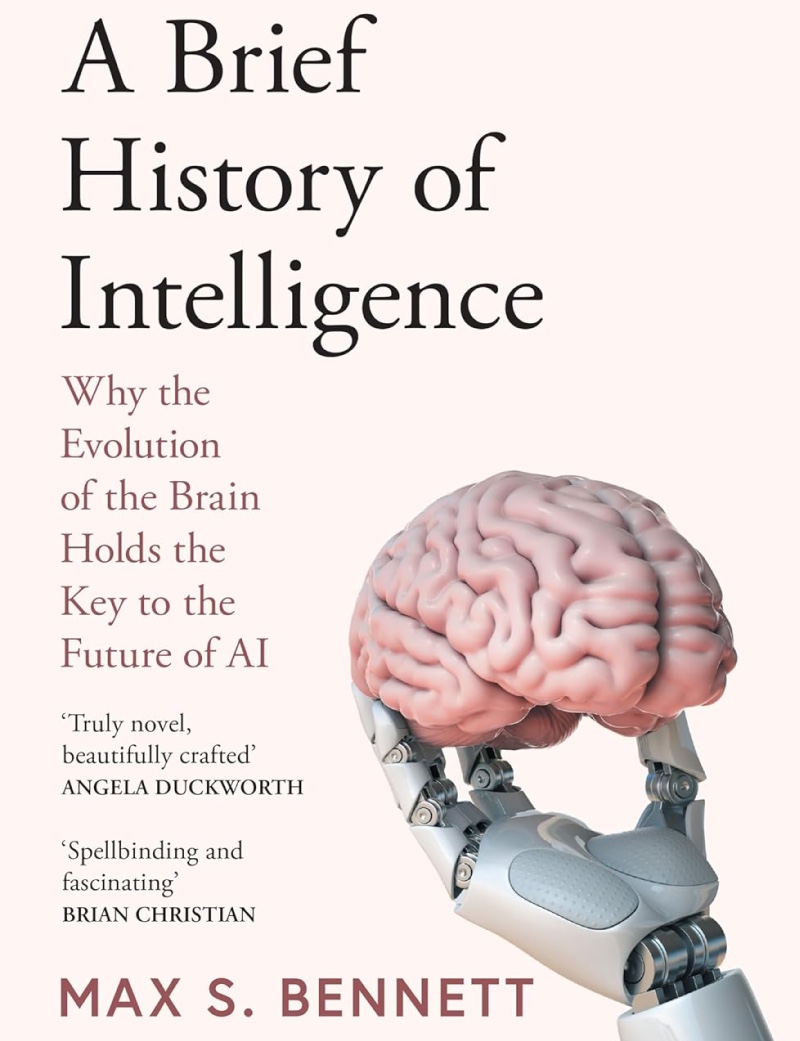
A Brief History of Intelligence : Evolution, AI, and the Five Breakthroughs That Made Our Brains
Max S. Bennett
The human brain has many secrets but in this book Bennett summarizes its development into five evolutionary leaps that provided the "hardware" for human behavior and thought. This is all backed up with examples from animals both living and fossil, with lots of interesting nitty-gritty detail.
Bennett is the CEO of an AI startup, which would normally make me wary but A Brief History of Intelligence seems on pretty solid evolutionary ground. Bennett spends most of the book going over the five "breakthroughs"for the curious: steering, reinforcing, simulating, predicting other metal states, communication that drive animal and human behaviors.
I found this book especially fascinating as someone who has dabbled in computer models, where surprisingly complex behavior can arise from fairly simple techniques. Bennett makes these connections then shows where simple models fall down as brains evolved over time.
Personally I think Bennett is drawing a long bow in some of the parallels made between human brains and AI but the evolutionary science in the book is detailed and up-to-date. A bit dryer than An Immense World but another book where I would read a chapter and then imagine being a flatworm for a while.